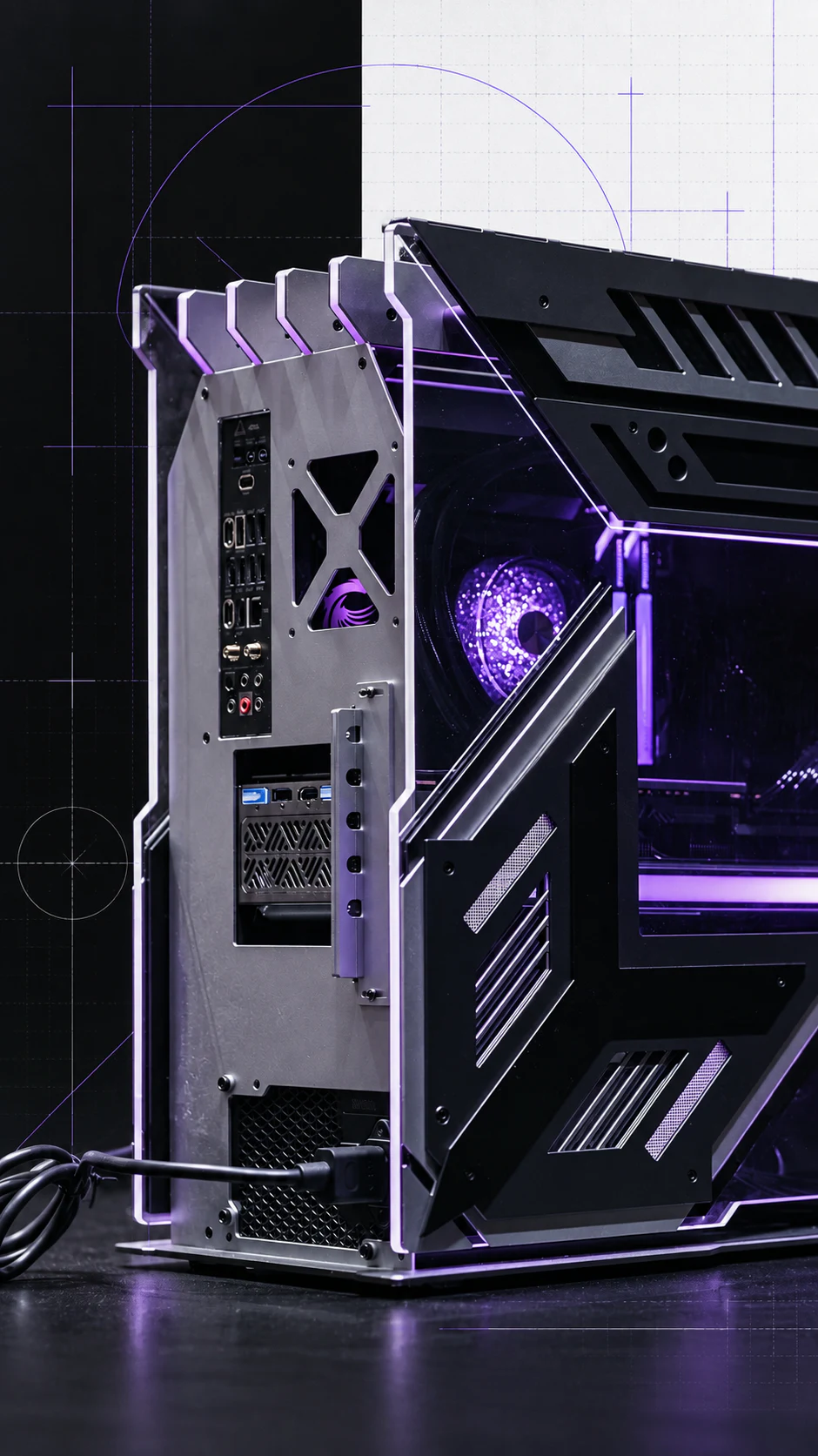
Businesses do not have to choose between using capable AI and surrendering every piece of information to an uncontrolled service. They do need to understand that “private AI” is not one product, one model or one installation choice. It is the result of decisions made across an entire system.
The short answer
Yes, a business can use AI while keeping tighter control of its information. Some systems can run entirely on equipment the business controls. Others use a private cloud environment, an enterprise API with contractual data controls, or a hybrid design that keeps sensitive material local while sending only limited tasks to an external model.
The right choice depends on what the system will see, what it will do and what would happen if the information were retained, exposed or used incorrectly. A local model may provide greater infrastructure control, but it can also be connected to insecure storage, excessive logs or poorly managed user accounts. A managed cloud service may process data outside the business boundary, yet offer mature security controls, clear retention terms and capabilities that would be expensive to reproduce locally.
This article is a practical decision guide, not legal advice. Data-protection obligations depend on the jurisdiction, the information involved and how the system affects people. A qualified legal or privacy professional should review consequential uses.
What is actually at risk?
The question “Will the AI company train on our data?” is important, but it is only one part of the picture. Business information can pass through several layers before a useful answer appears.
A user may enter a prompt. An application may add customer records, internal documents or previous conversation history. A retrieval system may create embeddings and store document fragments in a vector database. The model provider processes the assembled request. Monitoring tools record errors and performance. The application saves a transcript. A backup system copies that transcript somewhere else.
The real data path can therefore include:
- prompts, uploaded files and generated answers;
- retrieved document fragments and embeddings;
- conversation histories and application databases;
- diagnostic logs, traces and analytics;
- temporary files, caches and backups;
- connected email, CRM, calendar or messaging systems;
- human reviewers, administrators and support personnel.
Regulators and standards bodies consistently frame AI privacy as a risk-management problem rather than a single technical switch. The NIST AI Risk Management Framework includes privacy enhancement among the characteristics of trustworthy AI and expects risks to be considered across design, deployment, use and evaluation. The UK Information Commissioner’s Office similarly recommends a proportionate, risk-based approach that combines technical and organisational controls.
This leads to a better opening question: which information must the system process to produce the intended business outcome, and where does that information travel at every step?
Four practical deployment patterns
1. Managed consumer cloud AI
A team uses a general-purpose web application operated by an AI provider. It is usually the fastest route to useful capabilities and requires almost no technical operation by the business.
This can be appropriate for public information, low-sensitivity drafting, brainstorming and other work covered by the provider’s current terms and the organisation’s policy. It becomes risky when staff paste customer data, contracts, source code, credentials or confidential strategy into a tool without knowing which account type, settings and retention rules apply.
Consumer and business editions of the same product may handle data differently. The product name alone is not enough; the precise plan, controls and current terms must be reviewed.
2. Enterprise cloud or controlled API
The business uses a commercial API or enterprise product with documented commitments about training, retention, access, geography and security. This still uses external infrastructure, but it gives the organisation more control over the application and the data sent to the model.
Provider documentation illustrates why the details matter. OpenAI states that business-product and API inputs and outputs are not used for model training by default. Microsoft states comparable protections for models sold through Azure, while also documenting how optional stateful features, abuse monitoring and deployment geography can affect storage and processing. These controls are meaningful, but they do not secure the business application built around the API.
This pattern often fits organisations that need strong current models, elastic scale and lower operational burden, provided the contractual and technical controls match the information involved.
3. Private cloud or isolated environment
The model and supporting services run inside a cloud environment controlled by the business or its implementation partner. Network boundaries, encryption keys, identity management, storage and logging can be designed around organisational requirements.
This provides more control than a standard hosted application while retaining cloud scalability. It also creates more responsibility. Someone must configure the environment correctly, patch it, monitor it and understand which managed services still process information outside the intended boundary.
Private cloud is not a synonym for “nothing leaves our company.” It describes a controlled environment whose actual data flows still need to be verified.
4. Local or on-premise AI
The model runs on a workstation, server or device the business controls. Prompts and outputs can remain on that equipment, and the system may continue to operate without sending inference requests to an external model provider.
This can be valuable for sensitive document analysis, offline environments, predictable high-volume tasks or cases where data residency is a strict requirement. It can also limit model choice, speed or context capacity. Hardware, power, updates, security and technical support become the organisation’s responsibility.
Local systems are most useful when the privacy benefit is real and the task fits the available model—not when “local” is treated as a badge that overrides every other design consideration.
A decision table—not a universal ranking
Scroll sideways inside the table to compare every column
| Pattern | Control | Capability | Cost | Maintenance | Often fits |
|---|---|---|---|---|---|
| Managed consumer cloud | Lower | Often high and immediately available | Low entry cost | Provider-managed | Public or low-sensitivity work within policy |
| Enterprise cloud or API | Medium to high, depending on contract and design | High | Usage and integration costs | Shared with provider | Production systems needing capable models and documented controls |
| Private cloud | High when configured well | High but architecture-dependent | Higher setup and operations | Business or specialist partner | Regulated, integrated or residency-sensitive systems |
| Local or on-premise | Potentially highest infrastructure control | Depends on hardware and model | Hardware plus operations | Business or specialist partner | Sensitive, offline or predictable workloads |
The table describes common tendencies, not guarantees. A carefully configured enterprise API can be safer than an abandoned local server. A private environment can still expose information through a connected analytics service. A powerful cloud model may also need less data to complete a task than a weaker local model supported by a large internal knowledge store.
The comparison becomes useful only after the business defines what “control” means in its own situation.
Why local does not automatically mean private
Running inference locally removes one external transmission path. It does not eliminate every privacy or security risk.
The application may still call external services
A local model can sit inside an application that uses cloud speech recognition, analytics, crash reporting, web search or remote authentication. Each connection changes the data boundary.
Logs can reproduce sensitive content
Prompts, retrieved passages and generated answers may appear in diagnostic logs. Those logs can be copied to monitoring platforms or retained much longer than the primary application data.
Knowledge systems create additional copies
Retrieval-augmented generation often involves document processing, embeddings, indexes and caches. Even when the model is local, those components need retention rules, access controls and deletion procedures.
Local access can be too broad
A server inside an office is not private if every account has administrator access, passwords are shared or the device is not encrypted and patched. Physical location does not replace identity, permission and security management.
Updates and model files have a supply chain
Models, libraries, containers and plugins come from somewhere. Their origin, integrity and update process matter. Local operation increases control, but it also transfers more security responsibility to the operator.
The ICO’s information-security guidance for AI explicitly discusses access control, network separation, monitoring, encryption, secure development and supply-chain management. These are system properties. None appears automatically when a model is downloaded.
Make a proportionate choice
M4TIC’s recommended starting point is to classify the work before selecting the model or infrastructure.
1. Define the useful outcome
State the narrow task in operational language: summarize internal policies, prepare a response from approved documents, categorize requests, or extract fields from invoices. “Use AI” is not a defined outcome.
2. Minimise the information
Identify the smallest amount of data needed. Remove direct identifiers where they add no value. Avoid connecting an entire drive or CRM when the system needs only one controlled subset. Data that never enters the pipeline cannot leak from it.
3. Classify sensitivity and consequence
Public marketing copy, internal procedures, personal information, financial records and trade secrets should not share one default treatment. Consider both confidentiality and the consequence of an incorrect output or action.
4. Map the complete path
Document collection, retrieval, inference, output, logs, human review, integrations, storage, backups and deletion. Include the people and suppliers who can access each layer.
5. Select the lightest architecture that satisfies the controls
Some tasks can use an enterprise cloud product safely. Others justify a private cloud or local system. Hybrid designs are often practical: sensitive retrieval and preparation happen inside a controlled environment, while a carefully minimised request uses an external model for a limited step.
6. Test the real failure modes
Test unauthorized access, prompt injection, accidental disclosure, excessive retrieval, incorrect output and unavailable services—not only ideal demonstrations. Record who notices a problem and who can stop the system.
This process also prevents expensive overreaction. A business should not operate local infrastructure merely because “cloud” sounds unsafe, just as it should not adopt a cloud tool merely because its interface looks familiar.
What people should still control
Privacy controls do not make every automated decision appropriate. People should remain visibly responsible where context, rights or commercial consequences matter.
Human review is particularly important when a system:
- decides whether a person receives a service or opportunity;
- handles health, employment, legal or financial information;
- sends information outside the organisation;
- changes or deletes authoritative records;
- makes commitments to customers or suppliers;
- acts with incomplete evidence or uncertain identity.
The goal is not to place a person behind every generated sentence. It is to put review, approval and escalation at the points where mistakes become consequential. A well-designed system makes those points explicit instead of relying on users to remember invisible rules.
A useful next step
Before comparing model benchmarks or buying hardware, write down five things:
- the outcome the system should produce;
- the information it genuinely needs;
- the information it must never receive;
- the systems and people it must connect with;
- the actions that require human approval.
That short map will not answer every legal or technical question. It will reveal whether the business needs a managed tool, a controlled API, a private environment, a local model or a combination—and it will make conversations with technical, security and legal specialists far more productive.
Private AI is not the absence of external infrastructure. It is the presence of deliberate boundaries.
Sources and further reading
Primary guidance behind this article.
- Artificial Intelligence Risk Management FrameworkNIST
A voluntary framework for managing AI risks across design, deployment, use and evaluation.
- Opinion 28/2024 on certain data-protection aspects related to AI modelsEuropean Data Protection Board
European guidance concerning personal data, AI-model anonymity and lawful processing.
- Guidance on AI and data protectionUK Information Commissioner’s Office
Risk-based guidance for technical and organisational data-protection measures. The ICO currently marks this guidance as under review.
- Information security and integrity in AIUK Information Commissioner’s Office
Practical controls covering access, isolation, monitoring, encryption and supply-chain risk.
- Business data privacy, security and complianceOpenAI
Current provider documentation for business-product and API data handling.
- Data, privacy and security for models sold by AzureMicrosoft
Detailed documentation of processing, storage, monitoring and geography considerations in a managed enterprise service.