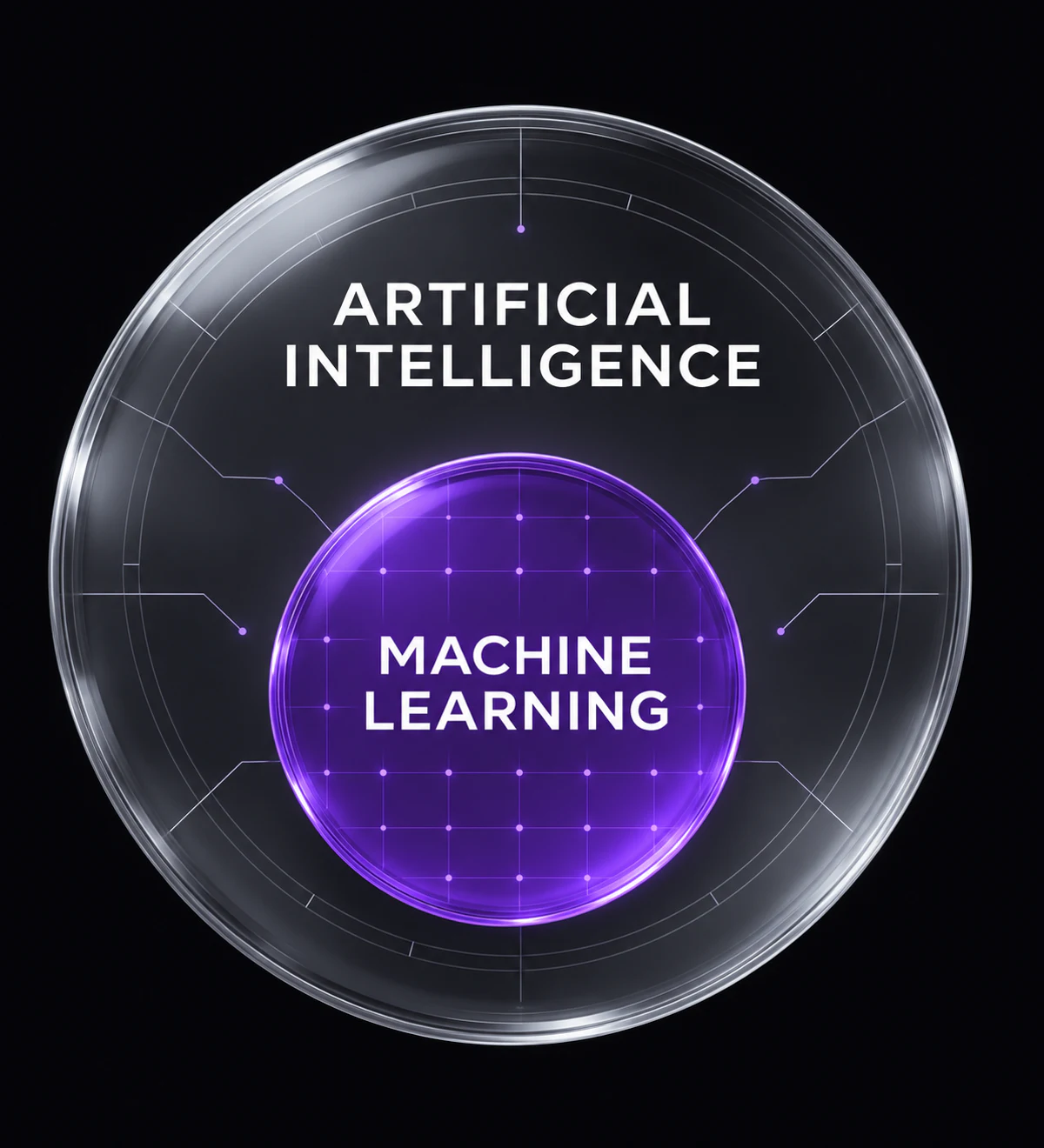
Artificial intelligence and machine learning are not interchangeable terms. AI is the broader field and system objective: producing outputs such as predictions, content, recommendations or decisions from inputs and objectives. Machine learning is one major family of methods used to build those systems; an ML model learns patterns from data instead of receiving every relationship as a written rule. That familiar definition is only the start. A real product also contains software, data flows, rules and controls—and those surrounding parts often determine whether it works safely.
AI vs machine learning: the practical difference
There is no single universal definition of artificial intelligence. A useful functional definition, reflected in OECD work, describes systems that infer from inputs how to generate outputs such as predictions, content, recommendations or decisions. The EU AI Act provides a legal definition for its own scope; it should not be treated as the only scientific definition.
Machine learning is narrower. It covers methods in which a model learns statistical or computational relationships from data for a task. This is the central difference between AI and machine learning: AI describes the broader field and system, while ML describes one family of methods that may power part of it. “Learns” does not mean that the model understands like a person, becomes conscious or improves by itself after deployment. People still design the objective, data pipeline, features, training process, thresholds, update cycle and use of the output.
Deep learning is a subset of ML that uses multi-layer neural networks to learn representations. It has enabled important results in perception, language and other fields, but it is not automatically the best method for every task. Suitability depends on the data, consequence of error, compute, latency, evidence and controls required.
AI model vs AI system: why the distinction matters
AI and machine learning blur together in product language because the most novel component often names the whole system. A vendor may say “the platform uses machine learning” even when the result depends equally on databases, programmed thresholds, search, interfaces, permissions and human review.
Take a system that estimates delivery-delay risk. The model may learn relationships from historical data. The business still chooses the target, accepted inputs, action threshold, recipient of the warning and fallback when confidence or data quality is insufficient. The prediction is learned; the operating meaning of that prediction is designed.
This distinction prevents two bad evaluations. One calls every automation “machine learning.” The other assesses the model in isolation even though the surrounding workflow can turn a reasonable prediction into the wrong action.
AI vs ML vs deep learning: the family-tree relationship
The familiar nesting is valid:
- AI is the broad field;
- machine learning is a family of approaches within it;
- deep learning is a family of methods within ML.
The family tree answers “which category contains which?” It does not describe a deployed system. It leaves out the objective, data flow, rules, integration, authority, monitoring and recovery.
It also should not be extended by placing generative AI, large language models and agents as successive rungs. Those terms describe different dimensions. Generative describes a kind of model behaviour or output. Agentic describes an architecture that coordinates components and actions.
More data does not guarantee better performance: relevance, quality, distribution, objective and validation all matter. Deep learning is not automatically superior to a simpler baseline either. The comparison belongs on the real task and the errors that matter in deployment.
Generative AI vs machine learning: behaviour and method
Generative AI and machine learning are not equivalent alternatives. A generative system produces synthetic content—such as text, images, audio or code—from patterns learned in data. Many current generative models use deep learning, but “generative” mainly describes what the model produces. It is not a universal layer that comes after deep learning.
A drafting assistant may combine a generative model with approved sources, retrieval, prompts, output schemas, filters and pre-send review. The model learned patterns during training. Retrieving a document at runtime is not the same as retraining it, and runtime memory is not automatically model learning.
For the decision about where this behaviour fits, see what generative AI can and cannot do.
AI without machine learning: rules, search and optimisation
Not every useful component learns from data. A system may include:
- explicit rules and thresholds;
- search and retrieval from authorised sources;
- database queries, formulas and deterministic calculations;
- optimisation methods;
- workflows, approvals and fallback paths;
- interfaces, identities, permissions and logs.
These components may surround an ML model. They may also solve the task without one. A fixed order-transfer workflow can be valuable precisely because it does not learn: the same authorised conditions should produce the same mapped result.
The practical question is not “where can we add AI?” It is “which component should produce which result, with what evidence and under whose control?”
AI agents vs machine-learning models: architecture and components
An agentic system may coordinate a model, tools, runtime memory, rules, loops, permissions and controls toward an objective. “Agent” describes how the system selects and uses components. It does not identify another family nested inside ML or deep learning.
Once the system can act, model quality is only one part of the evaluation. Tool choice, authority boundaries, approvals, logs, escalation and recovery become part of the evidence. What AI agents are and when to use them examines that architecture in more detail.
How to evaluate an AI system beyond its machine-learning model
M4TIC proposes four levels for reading a real system.
1. Operational objective and context
What result should the system produce, for whom and in which environment? Which decision or action will it influence, and what happens if it is wrong?
2. Result-producing components
Separate learned components—ML, deep learning and predictive, classificatory or generative behaviour—from explicitly programmed components such as rules, retrieval, optimisation, queries, formulas and workflows.
3. Orchestration
Determine whether the components follow a fixed sequence or an agentic architecture selects steps and tools within defined limits.
4. Cross-system controls
Locate data quality and provenance, evaluation, identity and permissions, human oversight, logging, monitoring, escalation and recovery. These controls belong to the deployed system, not just the model.
This map is an M4TIC editorial synthesis, not a standards taxonomy or compliance model.
Five AI and machine-learning examples—and the evidence to request
The following are illustrations, not client cases or performance evidence.
Scroll horizontally to compare every column
| Illustrative system | What learns | What is programmed | Evidence to request | Where controls sit |
|---|---|---|---|---|
| Fixed workflow: transfer an approved order into the operations system | Nothing, if fully deterministic | Trigger, mapping, conditions, validation and retry | Test cases, idempotency, error logs and recovery behaviour | Service identity, permissions, alerts and rollback |
| Predictive ML: estimate delay risk | Relationships between historical inputs and a target | Target, feature pipeline, threshold and business action | Temporal holdout, costly-error metrics, calibration and drift checks | Data governance, thresholds, review, monitoring and fallback |
| Deep-learning perception: classify defect images | Hierarchical representations from labelled images | Labelling protocol, training setup, threshold and routing | Representative tests, errors by class and condition, robustness | Input quality, confidence gate and human sampling |
| Generative AI: draft from approved sources | Model patterns; optional fine-tuning learns from selected examples | Prompt, retrieval, approved sources, schema and review | Task evaluation, source alignment, factuality, consistency and adversarial cases | Data boundary, human verification, filters, logs and send block |
| Agentic system: collect data and prepare a case file | The underlying model may be learned; runtime memory is not necessarily training | Tools, loop, policy, permissions, budget and stop/escalation | Task completion, tool choice, boundary adherence and recovery | Least privilege, approval, step/cost limits, audit and kill switch |
“What learns?” is not always the most important column. In the fixed workflow, no learning may be the desired property. In predictive ML, the evidence must show performance on representative data and expose the errors with the highest operational cost.
Four questions before choosing AI or machine learning
What learns?
Ask which model learns, from which data, toward which objective and through which update process. Keep training data, runtime input, retrieval and memory separate.
What is explicitly programmed?
List rules, thresholds, prompts, queries, tools, workflows, approvals and fallback. They influence behaviour even when the product story focuses on the model.
What evidence supports performance?
Request tests representative of deployment, metrics connected to costly errors, edge cases, comparison with a simple baseline and known limits. Aggregate accuracy can hide the error that matters.
Where do the controls sit?
Locate access, approval, logging, override, escalation, recovery and accountable ownership. If nobody can stop or correct the system, terminology is not the central problem.
AI vs machine learning: terminology is not evidence
Knowing the difference between AI, machine learning and deep learning is useful. It does not show that the data are suitable, the model beats a baseline, the workflow uses its output correctly or a failure can be contained.
When evaluating a proposal, ask for the complete system diagram and task-relevant evidence. A technical label can help you ask the first question. It cannot answer it.
Sources and further reading
Primary guidance behind this article.
- Explanatory memorandum on the updated definition of an AI systemOECD.AI
Functional system definition and recognition of machine-learning and knowledge-based approaches.
- Framework for the Classification of AI SystemsOECD.AI
System context and model building from data or human knowledge.
- Machine Learning — CSRC GlossaryNIST
Machine-learning definition with its source context.
- Adversarial Machine Learning: A Taxonomy and Terminology of Attacks and MitigationsNIST
Current predictive and generative ML taxonomy and lifecycle context.
- Deep learningNature — LeCun, Bengio and Hinton
Reference on multi-layer representation learning and major application areas.
- Artificial Intelligence Risk Management Framework: Generative AI ProfileNIST
Operational definition of generative models and system-risk framing.
- Regulation (EU) 2024/1689 — consolidated textEuropean Union
Scoped EU legal context for the AI-system definition and model/system distinction.
- Lessons Learned from the Consortium: Tool Use in Agent SystemsNIST
Context on models embedded in software scaffolding with tools that can act beyond text output.